
We were invited by NVIDIA to join their Inception Partners Showcase at AWS re:Invent. As you can imagine, the NVIDIA booth got a lot of foot traffic at re:Invent. During our four days of demos in the NVIDIA booth as part of this showcase, we gave thousands of demos to AI builders. In this post, I’ll summarize a few of our takeaways from the event.
Mop the slop
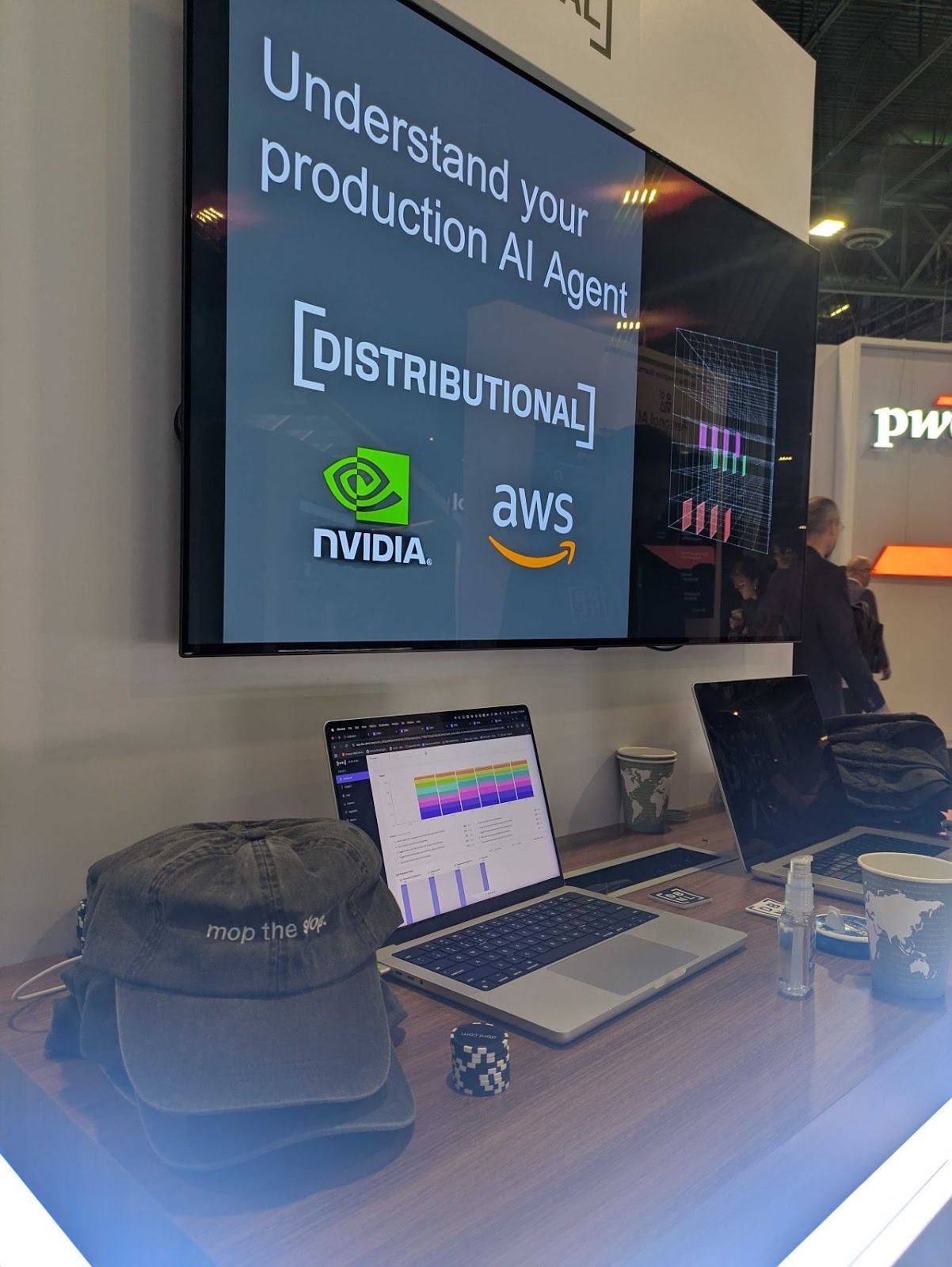
Our theme for the event was mop the slop, complete with dusty dad hats bearing the call to action. Our mission is to empower AI teams to understand AI behavior so they can build more reliable, refined, and capable AI products. When Distributional gives AI product teams recommendations for improvements and fixes to their production agents, our goal is for them to get into a virtuous product improvement cycle. Insights lead to changes that drive performance. As teams engage with these insights, they mop up some of the slop around how their agents are behaving, which drives a better user experience.
Open production agent stack
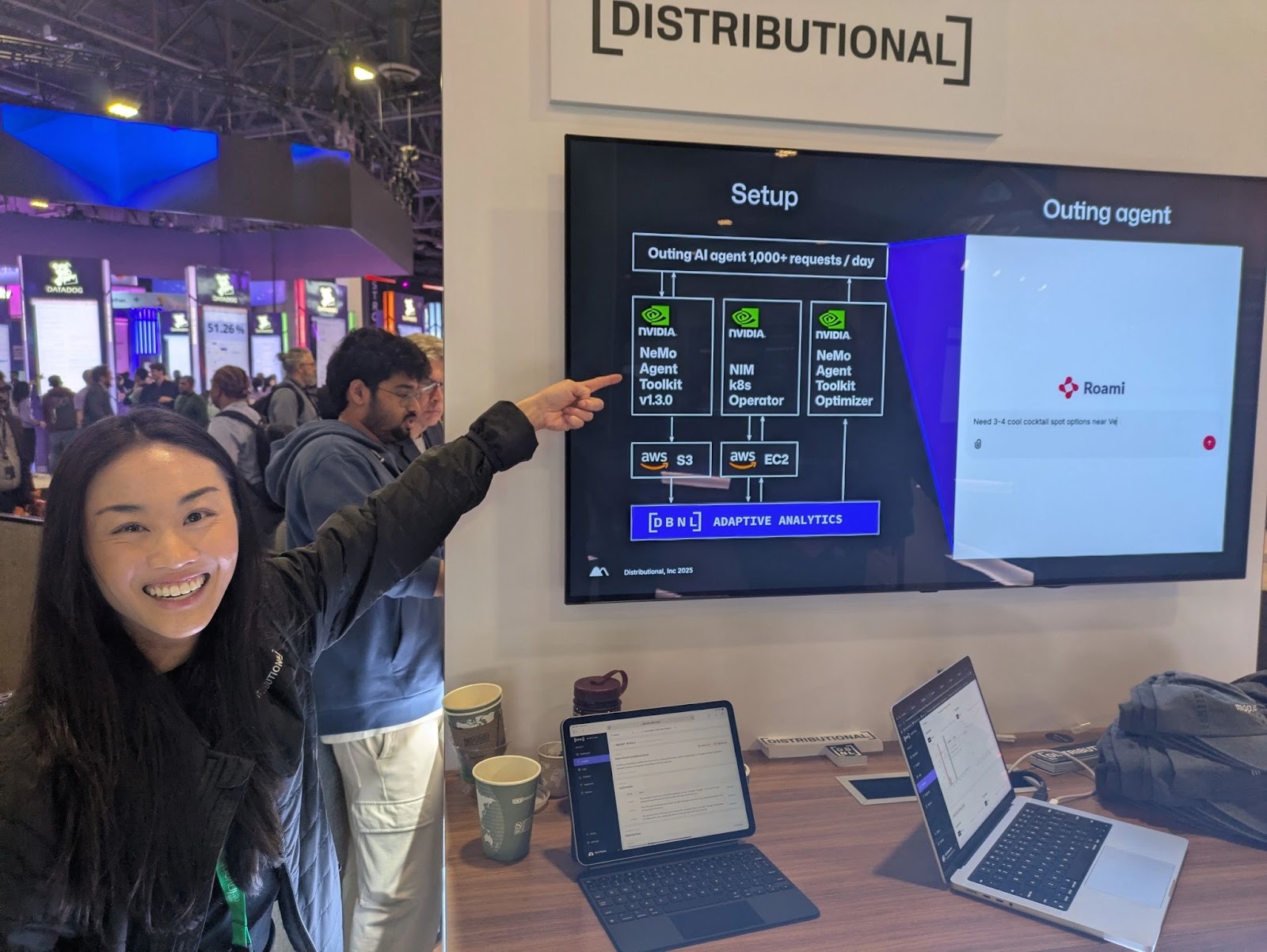
During the week, we gave a demo that focused on giving AI builders an open, easy to use, and installable production agent stack. In this demo, we used NVIDIA NeMo Agent Toolkit v1.3.0 for our framework, we ran our LLMs for the agent using NVIDIA NIM k8s Operator, and we ran the NVIDIA NeMo Agent Toolkit Optimizer to tweak the parameters of the agent to boost performance based on feedback from Distributional. We used S3 for storage and EC2 for compute. And, of course, we used Distributional as the openly distributed package for analytics. This setup worked well for the outing agent we built for this demo. Our goal was to give developers a ready-made production agent stack they could use in their own workflow, and we consistently received good feedback on it through the week. Mission accomplished!
Agent analytics drive AI observability
Helen Yu runs an interview series called CXO Spice and came by our booth to interview Scott. Their conversation chewed on the idea that the pathway to improving performance for LLM-based agents is predicated on first understanding their behavior, and then using this context to make decisions on how to develop them further. This shift—from training models to optimize performance to analyzing their behavior to understand it—is what led to the founding of Distributional. We also discussed how agents are starting to mature in the enterprise, and as these agents scale, analytics become a critical component of the stack that gives teams this understanding—and, in turn, the boost in performance that comes with it.
You can read Helen’s summary of the interview here. Or watch the interview yourself here:
The year of AI agents…again
We spoke with thousands of AI builders during the event, and it is impossible to accurately capture all of the takeaways from these discussions. But one theme that was very clear: it may be the year of agents…again. Among many other conversations, I spoke with a F500 payments company, a F500 telecom provider, a multi-billion dollar social media tech company, a unicorn education startup, one of the big four consulting firms, a F500 insurer, a global financial technology company, and one of the largest credit card networks. None of them were as far along as expected with agents. Each of them had made significant progress. And each of them expected agents to take over significant core internal workflows by the end of 2026.
At risk of crying wolf once again—coupled with real advances in foundation models that enable agent workflows—this progress could finally result in the year agents break through in a meaningful way across large enterprises. We’re looking forward to seeing that happen.
Get started
Distributional is a free, open, and installable platform for agent analytics. Try it today and quickly learn how it complements your existing agent observability stack. We are also always happy to learn more about your use case and enterprise needs, so reach out to contact@distributional.com with any questions.
Subscribe to DBNL
Thank you for your submission!
Oops! Something went wrong while submitting the form.